Is HIPAA Applicable in Canada? Here's What Actually Applies to Your Clinic
Picture this – it’s a Tuesday afternoon, the waiting room is full, and your front desk person is filling out a vendor security questionnaire for a new practice management system. Question 4 asks, “Is your organization HIPAA compliant?”
She pauses. Types “Is HIPAA applicable in Canada” into Google. Gets three different answers on three different websites. Closes the laptop and goes back to checking in patients, because now there’s a line and this can wait.
If that sounds familiar, you’re not alone, and you’re not wrong to be confused. Let’s clear this up properly.
The short answer:
No, HIPAA does not apply to Canadian clinics.
But that answer, on its own, isn’t actually that useful to you. The real question your clinic needs answered isn’t “does HIPAA apply to me.” It’s “what law does apply to me, and am I following it?” These are important questions that show you have the intent of keeping patient data safe.
HIPAA — the Health Insurance Portability and Accountability Act — is a US federal law. It governs how American healthcare organizations handle patient information, and it’s enforced by the US Department of Health and Human Services. A dental office in Kelowna or a family clinic in Mississauga is not legally bound by it, no matter what a vendor form or a software vendor’s marketing page might suggest.
Why Canadian Clinics Keep Searching for HIPAA Compliance
So why does everyone keep asking about HIPAA?
Because it’s genuinely everywhere, and often used as shorthand for, ‘healthcare privacy compliance regulations. If you’ve bumped into HIPAA while running a Canadian practice, it’s probably because of one of these:
- A cloud-based EMR or scheduling tool built by a US company mentions HIPAA compliance on its website, and you assumed it applied to you too.
- A cross-border insurer, US-based patient, or American partner clinic sent you a questionnaire referencing HIPAA.
- A vendor security review at your clinic used a template built for a US audience.
- You searched “healthcare privacy compliance” and every top result happened to be written for an American reader, because HIPAA content dominates the search results.
None of that means HIPAA governs your clinic. It just means the internet’s default healthcare privacy conversation is American, and Canadian clinics get swept up in the terminology.
That’s a search problem, not a legal one.
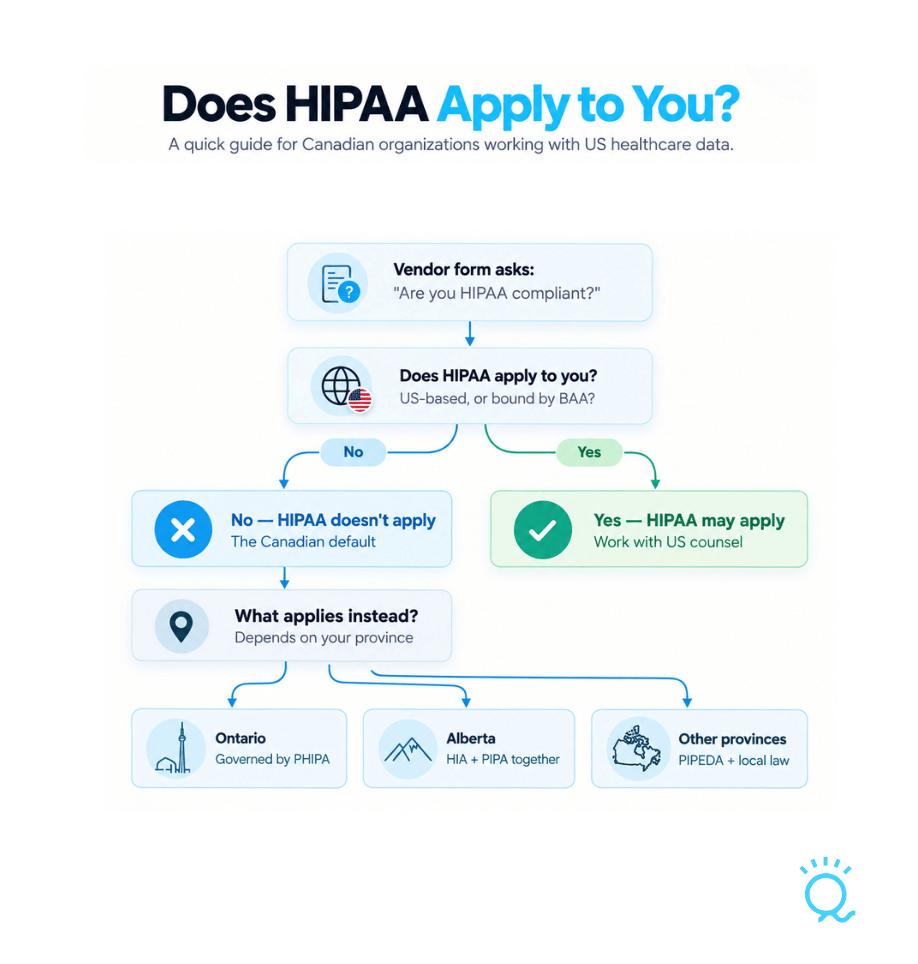
PIPEDA, PHIPA, and Canadian Healthcare Privacy Laws
So, here’s what actually applies to your clinic in Canada.
Canadian healthcare privacy runs on a different set of rules, and which ones apply depends partly on where you’re located.
PIPEDA (the Personal Information Protection and Electronic Documents Act) is the federal baseline. It applies to private-sector organizations, including most clinics, that collect, use, or disclose personal information, including health information, in the course of commercial activity. However, PIPEDA is not specific to healthcare information.
PHIPA (the Personal Health Information Protection Act) governs health information custodians in Ontario specifically, and because it pertains directly to health information, it supersedes PIPEDA when it comes to healthcare privacy compliance in Ontario. If your clinic is in Ontario, PHIPA is usually your primary framework, not PIPEDA.
Provincial legislation fills in the rest, and it often does more of the work than people expect. In Alberta, the Health Information Act (HIA) governs how “custodians”, like physicians, dentists, pharmacies, physiotherapists, and other healthcare providers, collect, use, and disclose health information, and it sits alongside the Personal Information Protection Act (PIPA), which covers Alberta’s private-sector organizations more broadly, including the administrative and non-clinical side of a practice. So an Alberta clinic isn’t just working with one law HIA covers the health information, while PIPA can apply to other personal information the clinic handles, like employee records or general business data. British Columbia, Quebec, and other provinces each have their own equivalent frameworks, some healthcare-specific, some general.
The practical takeaway: a Canadian clinic doesn’t get to pick the Canadian version of HIPAA off a shelf (there isn’t one). Your obligations depend on your province and the kind of organization you run.
That’s less tidy than one national rule, but it’s the reality.
A Recent PHIPA Compliance Case Shows Why This Isn’t Just Theory
In August 2025, Ontario’s Information and Privacy Commissioner (IPC) issued its first administrative monetary penalty under PHIPA, against a physician and his private clinic. The finding wasn’t about a single email sent to the wrong person or one dramatic hack.
The IPC’s decision described the clinic as lacking the essential elements of a data privacy and security governance program altogether, no real structure around how patient information was protected day to day.
That’s the part clinic owners tend to miss. Privacy breaches don’t only happen from a stolen laptop or a headline-grabbing ransomware attack (though those happen too like in the case of southwestern Ontario hospitals that lost access to systems and had patient data stolen in a 2023 ransomware incident that started through a third-party vendor).
More often, the risk is quieter: no documented policies to address privacy risk, no access controls, no plan for what happens if something goes wrong. Regulators are now treating that absence itself as a compliance failure, not just the breach that eventually results from it.
Next Steps for Healthcare Compliance in Canada
If your clinic has been Googling HIPAA and coming up with the wrong answers, that’s a sign it’s time to get clear on what actually applies to you: PIPEDA, PHIPA, or your province’s health information law. It also means that it’s time to look honestly at whether your current email, forms, and communication habits would hold up to the kind of scrutiny the Ontario IPC applied in that 2025 case.
Brightsquid works with Canadian clinics on exactly this: secure, healthcare-specific communication tools built around how clinics actually operate, plus practical compliance training and advice that helps your team understand what to do with the information they handle every day. Not a HIPAA badge you don’t need, but a way to turn Canadian privacy requirements into everyday practice.
FAQs About HIPAA Compliance Canada
Can a Canadian clinic be HIPAA compliant?
It can be, but it’s not always very useful. HIPAA compliance is a US regulatory designation that doesn’t map onto Canadian law. What a Canadian clinic can do is meet PIPEDA, PHIPA, or the relevant provincial requirements, and build security practices strong enough to satisfy a US partner’s expectations if that ever comes up.
If HIPAA doesn’t apply here, why do vendors and partners keep asking about it?
Because a lot of software and questionnaires are built for a US-first market, and “HIPAA compliant” gets used loosely as shorthand for “takes patient data privacy seriously.” If a US partner specifically needs HIPAA-level assurances, that’s a conversation about your security practices and any business associate arrangement, not about a law that binds your clinic.
What should our front desk staff actually understand about this?
Not legislation citations. What matters day to day is simpler: which tools are safe to send patient information through, what to do if information goes to the wrong person, and who to tell when something feels off. That’s a training question as much as a technology one.